Grade 1: Notes & note values: Introduction
The following are the basic notes that you will need to know for your grade 1 exam.
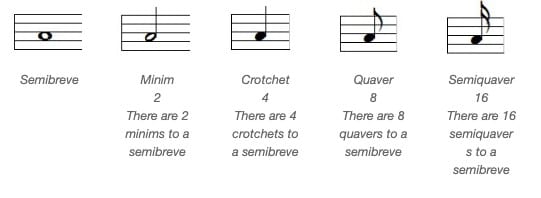
The Semibreve
In music, a semibreve is a note that typically lasts four beats in common time (4/4).
-
It’s also called a whole note in American terminology.
-
It’s written as a hollow oval with no stem: 𝅝
-
In terms of duration, it’s twice as long as a minim (half note) and four times as long as a crotchet (quarter note).
-
In older music notation, it was one of the longest note values, which is why “semi-breve” literally means “half-short” in Latin—it was half the length of the breve.
If you think of a bar of 4/4 time, a semibreve would fill the entire bar with a single sustained sound.
The Minim
In music notation, a minim is a note that lasts two beats in common time (4/4).
It’s also called a half note in American terminology.
-
Symbol: An open (hollow) oval note head with a straight stem.
-
Duration: Twice as long as a quarter note (crotchet) and half as long as a whole note (semibreve).
-
Example in 4/4: If the beat is a crotchet (quarter note), then a minim would last for two beats — you’d count it as “1–2” or “3–4.”
Basically, if crotchets are walking, minims are like taking a slower stroll — you hold the sound twice as long.
The Crotchet
In music, a crotchet is the British term for what Americans call a quarter note.
-
Value: It lasts for one beat in common time (4/4).
-
Appearance: It has a filled-in (black) oval note head with a straight stem.
-
Function: It’s one of the basic rhythmic units, often used as a steady pulse or beat reference.
So if you’re tapping along to a song in 4/4, each tap usually matches the duration of a crotchet.
The Quaver
In music, a quaver is a note that lasts for half the duration of a crotchet (quarter note).
-
In 4/4 time, a crotchet gets 1 beat, so a quaver gets half a beat.
-
In written notation, a quaver is shown as a filled-in oval note head with a stem and one flag (or one beam if grouped with other quavers).
-
If you see two quavers joined by a beam, each still counts for half a beat.
In everyday terms: if you tap your foot to the beat of a song, a quaver is played twice as fast as the beat.
The Semiquaver
In music, a semiquaver is a note that lasts for one-sixteenth of the duration of a whole note (semibreve).
-
In 4/4 time, a semiquaver is one-quarter of a beat (since a beat is usually a crotchet/quarter note).
-
It’s written as a small filled-in note head with a stem and two flags (or two beams when joined to other notes).
-
In faster passages, semiquavers create rapid, flowing movement.
For example, in 4/4 time:
-
1 semibreve = 4 beats
-
1 crotchet = 1 beat
-
1 quaver = ½ beat
-
1 semiquaver = ¼ beat
🎵 Think of it like: if a crotchet is “ta,” a semiquaver is “tika” — quick and snappy.
Grade 1: Notes & note values
Please note: The grade 1 to 5 theory exams are now online. Some of the questions in the online exam have been rephrased to accommodate the new style. In this video tutorial some of the descriptions refer to the written paper of old. With regard to the online exams you will no longer be required to write your answers but you will need to analyse the questions and tick or highlight an answer.
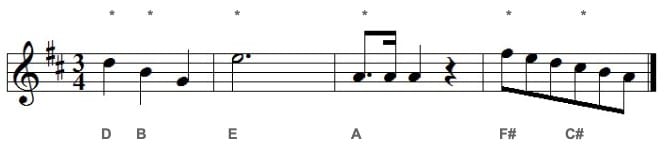
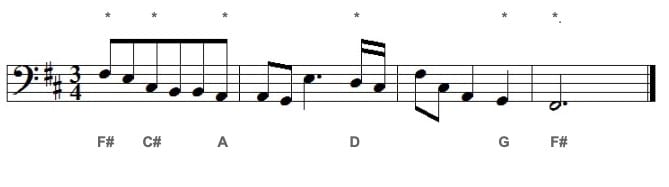
You will be required to give the letter name of notes on either a treble or bass clef. You will need to include the sharp or flat sign where necessary.
Give the letter name of each of the notes marked *, including the sharp or flat sign where necessary. The first note is given.
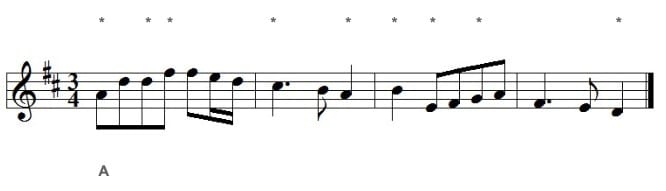
Answer 1
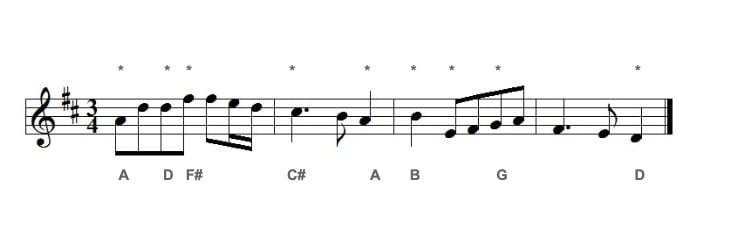
Write the notes below on manuscript or print this page then complete the question.
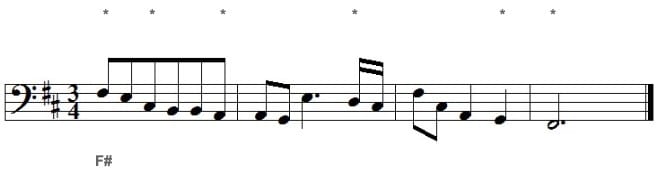
Give the letter name of each of the notes marked *, including the sharp or flat sign where necessary. The first note is given.
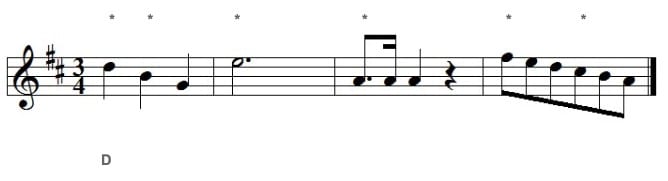
Answer 2
Question 3
Write the notes below on manuscript or print this page then complete the question.
Give the letter name of each of the notes marked *, including the sharp or flat sign where necessary. The first note is given.
Answer 3
Top of Page
 English
 Welsh
Welsh